

Magnet Mills sites sold
Separate buyers acquire properties, redevelopment plans not announced
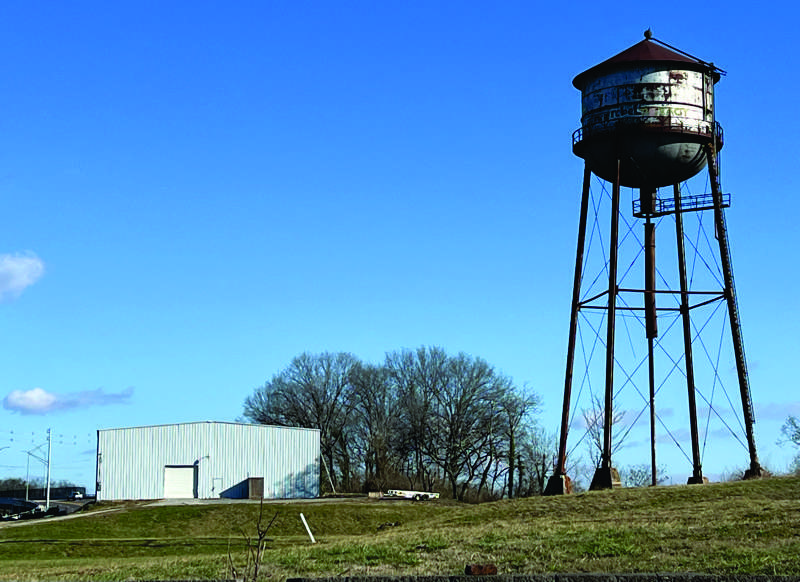
The historic water tank sits overlooking the two separate tracts that once housed the Magnet Mills hosiery plant next to CVS Pharmacy on Charles G. Seivers Boulevard in Clinton on Monday. Both sites reportedly have been sold to potential developers. (photo:G. Chambers Williams III )
Property records available online show that Ted Duke of Knoxville on Dec. 15 purchased the 3.38-acre site that includes a 20,000-square-foot metal building, for a reported $1.25 million.
Duke operates Production Components Inc., a Knoxville industrial company, and has been renting the prefabricated building on the Magnet Mills site, reports indicated.
Duke did not return phone calls from The Courier News on Monday seeking comment.
No buyer’s information had shown up yet as of Monday on the state property viewer website for the second tract, 3.59 acres, next door to CVS Pharmacy on Charles G. Seivers Boulevard.
That’s the site that holds the iconic Clinton water tower, but it has no other structures on it.
The two large brick buildings that once housed the hosiery mill were heavily damaged by fire in 2016, and the lot has since been cleared – except for the water tower, which is on the National Register of Historic Places.
The previous owner of the property obtained a demolition permit for the water tower from the city of Clinton in March 2018, but after blowback from residents and some members of the City Council, the tower was never taken down.
According to information from the Archives of Appalachia at East Tennessee State University, the plant opened its doors in 1906 as Magnet Knitting Mills.
“In 1929, the Mill was incorporated as Magnet Mills, Inc., a locally owned and operated hosiery mill,” the report says. “In 1965, the mill was sold to Messrs. Frank and Samuel Burd of San Francisco, California. After the sale, the local management of the mill remained largely unchanged.
“In March 1967, a prolonged strike with Local 2125, Textile Workers Union of America, resulted in a management decision to close the mill down permanently.”
At its height of operations, the mill reportedly had more than 1,000 workers.
Clinton city officials had dealt for years of with code violations brought on by neglect of the abandoned industrial site.
The city has said that a complete environmental assessment of the property would be necessary before anything new could be built on the site, as various potentially dangerous chemicals had been used in the manufacture of the women’s hosiery at the plant.