
Flock fight grows
Mayor backs halt as residents raise concerns
-
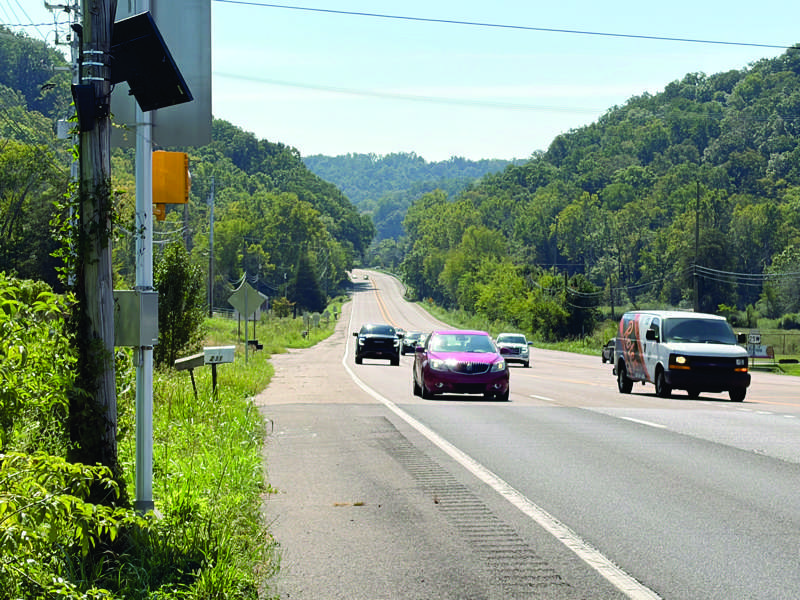
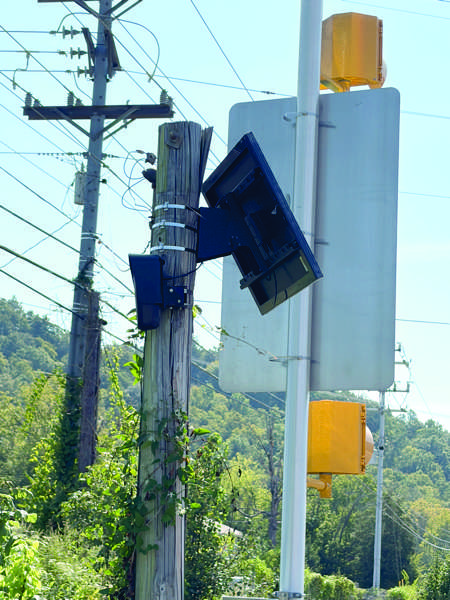
This Flock camera at the Racoon Valley Road and Clinton Highway intersection is one of the cameras the Anderson County Sheriff’s Office uses. ACSO Public Information Officer and Anderson County Commissioner J. Shain Vowell told The Courier News a vandal had damaged it, which is why it is pointing away from traffic. The other fixed ones, he said, were still functional. - Tony Cox
-
Flock camera - Tony Cox
-
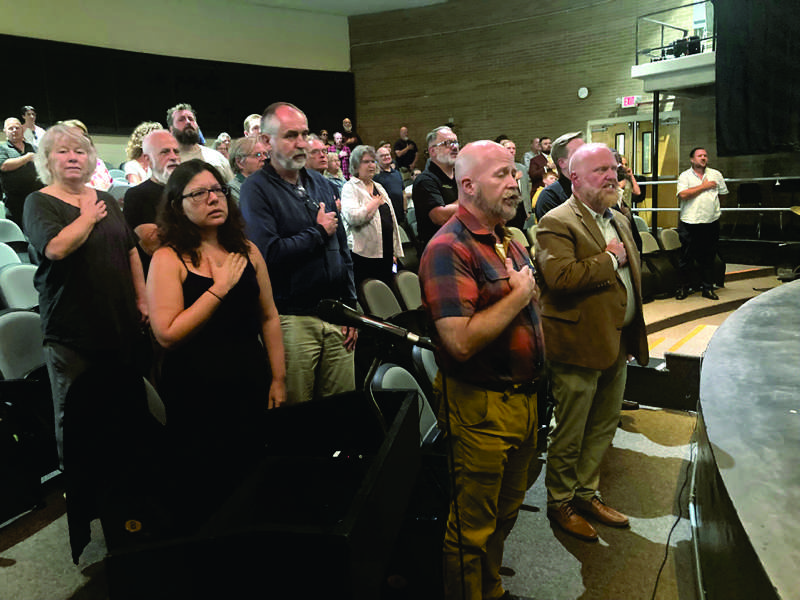
A crowd showed up to discuss Anderson County’s use of Flock license plate reading cameras at Clinton High School’s auditorium with Anderson County Operations Com- mittee. They all stood for the Pledge of Allegiance at the meeting’s start. In the front row are Oak Ridge resident and one of many critics of Flock cameras at the meeting Nathan Mullins who referred to it as an example of “government overreach” and profiteering.” Next to him is Anderson County Sheriff Russell Barker who defended Flock cameras and called them the “biggest crime fighting tool since DNA.” - Tony Cox
Anderson County Mayor Terry Frank says she wants to end or pause Anderson County’s use of Flock cameras.
Any decision involving cameras used by the Anderson County Sheriff’s Office, however, would need approval from the Anderson County Commission.
The county has three cameras mounted on poles in stationary locations and a fourth portable camera.
Frank made her statement at the end of a public hearing held by the Anderson County Commission’s Operations Committee on Sept. 10 in the Clinton High School auditorium, 425 Dragon Drive.
Thirty-one citizens spoke at the meeting, all opposing the cameras.
Concerns raised included privacy and constitutionality; the possibility of hackers gaining access to the Amazon cloud storage system; law enforcement officers abusing the system for stalking; false positives involving license plates from other states; automated cameras replacing police work; and the possibility of a future government using the cameras to enforce more-restrictive laws.
“You don’t know who will govern after you,” said Sarah Fluegel, an assistant at the Oak Ridge Public Library and one of the citizens who spoke.
Frank said, however, that statements by representatives of the Anderson County Sheriff’s Office and Flock Safety who spoke in favor of keeping the cameras helped convince her that the county should end or pause their use.
“I can definitely see the benefits,” Frank said. “However, we had the Flock representative say they will be at every legislature in the coming sessions helping craft comprehensive policies. That is an admission that there’s some weaknesses, some issues with the systems that they themselves acknowledge.”
She was referring to Jaylen Johnson, public affairs manager for Flock Safety, the company that makes the county’s Flock Falcon automated license plate-reading cameras. Johnson spoke at the meeting and answered questions from audience members and committee members.
“Do we wait for them to be addressed?” Frank asked regarding issues with Flock cameras. “Do we accept what may be wrong during the meantime?”
Frank also said Anderson County Sheriff Russell Barker’s statement that a sheriffs association was working on a policy made her question whether the existing policy was adequate.
Sheriff’s Detective Adam Warren said the office’s Flock cameras are located at Clinton Highway and Raccoon Valley Road; East Wolf Valley Road and Norris Freeway; and North Main Street at Interstate 75 in Rocky Top. The county also has a mobile camera, which Warren said is currently out of service.
Warren said the Sheriff’s Office shares its license plate data with 1,600 other agencies and entities. None, however, are federal agencies such as the Department of Homeland Security, U.S. Immigration and Customs Enforcement or the FBI, because the county specifically chose not to share with federal agencies.
Five of the 1,600 are law enforcement agencies within Anderson County: Oak Ridge, Clinton, Oliver Springs, Norris and Rocky Top. The others, Warren said, are agencies “all over the nation,” including other East Tennessee counties.
“For us to be able to see their cameras, they have to be able to see our cameras,” he said regarding the arrangement with Clinton.
Warren said most Sheriff’s Office deputies can search only East Tennessee camera information, while some personnel, including detectives, can search elsewhere.
Barker, Warren and Johnson argued that the cameras make investigations easier.
“When a child goes missing, every second, every minute matters,” Johnson said, arguing that the cameras speed up such investigations.
Warren cited several investigations in Anderson County that he said were assisted by Flock cameras, including cases involving a stolen motorcycle and methamphetamine; a stolen license plate and fentanyl; the robbery of the 76 gas station outside Rocky Top, which he said was solved in three hours; a prevented drive-by shooting; and Jason Dockery’s fatal shooting of Shysti Mayberry.
Barker called the cameras the “best crimefighting tool since DNA.” He said those attending the meeting were not necessarily representative of the entire county and suggested putting the county’s use of Flock cameras to a’vote.
Operations Committee member Tracy Wandell, however, said the fact that no members of the public spoke in favor of the cameras was significant.
“Thirty-one of them spoke,” Wandell said of the members of the public. “Thirty-one of them were against it.”
Warren said Sheriff’s Office personnel must enter a case number and the reason for a search before receiving results from the system. The database, he said, can provide the camera location, date, license plate number, vehicle make, model and color, as well as the presence — but not the content — of bumper stickers.
Former Oak Ridge City Councilwoman Anne Garcia, who was in the audience, pointed out that people can use license plate information to search for other information.
Warren also said his audits and Flock’s artificial intelligence can identify abnormal searches by officers, although one audience member noted that such reviews occur after a search has been conducted.
Johnson said license plate images captured through motion detection are stored in an Amazon cloud system for 30 days and automatically deleted after that period.
Operations Committee Chairman Tim Isbel said at the committee’s Monday, Sept. 14, meeting that he plans to wait until the committee’s October meeting to further discuss the issue before voting on a recommendation to the County Commission.
Isbel encouraged commissioners to hold town hall meetings in their districts, which Barker said he would attend.
Isbel said he wants answers to questions Johnson did not address at the public hearing and wants that information provided to residents “out of fairness to the public.”
Those questions include whether homeowners associations can access Flock data and a provision in the county’s current agreement involving the use of Anderson County for marketing purposes.
Isbel said Barker’s proposal to put the issue to a referendum was not practical because it could delay action by two years.